
How Many People Live in New York City?
New York City is home to roughly 8.4 to 8.8 million people, depending on whether you look at the latest estimates from the NYC Department of City Planning or the official 2020 U.S. Census count. The wider New York metropolitan area is far larger, with a population of about 19 to 20 million residents (U.S. Census Bureau). These differences come down to timing, methodology, and whether a source is measuring the city limits or the entire metro region.
The most recent U.S. Census Bureau update put NYC’s population at 8.58 million as of July 2025. Most population figures you see online fall into one of three categories: the official Census count, updated city-level estimates released by NYC planners, or independent projections that attempt to model monthly or annual shifts. Using a blend of these sources gives the clearest picture of how many people live in New York at any given moment.
NYC Population by Borough
Based on the 2020 Census and New York City Department of City Planning data, the city’s 8.8 million residents are divided across the five boroughs roughly as follows:
Brooklyn (Kings County) – About 2,736,000 residents in 2020. Neighborhoods like Williamsburg, Bushwick, Park Slope, Crown Heights, and Brooklyn Heights help make Brooklyn the most populous borough and home to roughly one third of New Yorkers.
Queens (Queens County) – About 2,405,000 residents in 2020, the second most populous borough and just behind Brooklyn in total population. Queens includes major residential hubs such as Astoria, Long Island City, Flushing, Jackson Heights, and Forest Hills, giving it a population just behind Brooklyn.
Manhattan (New York County) – About 1,694,000 residents in 2020. Neighborhoods like the Upper East Side, Upper West Side, Harlem, Washington Heights, Chelsea, and the East Village sit within the borough with the smallest land area but some of the highest neighborhood-level densities in the country.
The Bronx (Bronx County) – About 1,472,000 residents in 2020, giving it a record high population and solidifying its role as home to roughly one in six New Yorkers. The borough encompasses major communities such as Riverdale, Fordham, Pelham Parkway, and Mott Haven.
Staten Island (Richmond County) – About 496,000 residents in 2020, making it the least populous borough, though still larger than many standalone U.S. cities. Areas like St. George, Tottenville, West Brighton, and Great Kills give Staten Island a more suburban feel while still housing more residents than many standalone U.S. cities.
Together, these five boroughs make up New York City’s overall population, but the differences in size and density explain why each one can feel like its own city within the city.
NYC Population Density by Borough
New York City’s density varies dramatically from one borough to the next. Manhattan is the most crowded, with compact neighborhoods, limited land area, and some of the highest residential densities in the United States. The other boroughs have more space, more varied housing, and lower overall density, even though they hold large populations in their own right.
Approximate density figures based on 2020 Census population and land area measurements show the contrast clearly:
Manhattan – More than 70,000 residents per square mile, the highest borough density by a wide margin.
Most dense areas: Midtown, Lower East Side, East Village, and parts of Hell’s Kitchen
Least dense areas: Marble Hill, Inwood, and parts of Washington Heights
The Bronx – Roughly 34,000 residents per square mile, reflecting a mix of dense neighborhoods and significant parkland.
Most dense areas: Fordham, University Heights, Highbridge, and Mott Haven
Least dense areas: Riverdale, Country Club, and Throgs Neck
Brooklyn – Around 38,000 residents per square mile, with large variations between rowhouse neighborhoods, waterfront areas, and rapidly growing districts.
Most dense areas:Williamsburg, Bushwick, Borough Park, and Crown Heights
Least dense areas: Bay Ridge, Marine Park, and parts of Gerritsen Beach
Queens – Approximately 21,000 residents per square mile, balancing dense urban centers with more residential, low-rise areas.
Most dense areas: Jackson Heights, Elmhurst, Long Island City, and Flushing
Least dense areas: Bayside, Douglaston, and parts of Forest Hills
Staten Island – About 8,000 residents per square mile, giving it the most suburban feel of the five boroughs.
Most dense areas: St. George, Stapleton, and parts of Tompkinsville
Least dense areas: Tottenville, Great Kills, and Emerson Hill
These figures underline why Manhattan feels so compressed compared to outer borough neighborhoods and why experiences of “crowdedness” vary widely depending on where someone lives or works within the city.
How NYC’s Density Shapes Daily Life
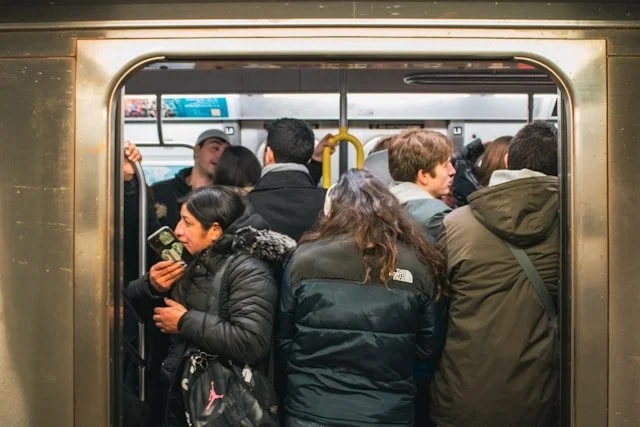
Density helps explain why New York can feel like several cities in one. Manhattan’s extreme concentration of people supports packed sidewalks, frequent transit, and a skyline of tall buildings. Brooklyn, Queens, and the Bronx mix dense apartment blocks with quieter residential pockets and large parks. Staten Island’s lower density gives it a more suburban feel. Commutes, housing options, and how crowded a neighborhood feels all trace back to these underlying density patterns.
Why NYC Population Numbers Don’t Always Match
Population figures differ because they describe different geographies and rely on different data cycles. Some sources report only the population within New York City’s official boundaries, while others include the entire metropolitan area stretching across New York, New Jersey, and Connecticut. Annual updates from city agencies can shift numbers slightly as new housing, school enrollment, and migration data come in. Census figures remain fixed until the next national count, which is why many articles still reference the 2020 total even as more recent estimates show moderate change.
How NYC’s Population Has Changed Over Time
New York City’s population has shifted in notable ways over the past two decades. From 2000 through 2020, the city experienced steady growth driven by immigration, job expansion, and strong housing demand in several boroughs. The 2020 Census captured the peak of that long climb, recording nearly 8.8 million residents across the five boroughs.
The early 2020s brought a temporary dip as many households moved during the pandemic. More recent city planning estimates show that trend reversing, with the population rising back into the mid-8 million range by 2024. Much of this recovery reflects people returning for work, school, and housing, along with ongoing international migration that has historically played a major role in New York’s growth.

FAQ About NYC’s Population
Is the NYC Population 8 Million or 18 Million?
The lower figure refers to the population within New York City’s five boroughs. The much larger number refers to the broader New York metropolitan region, which includes surrounding counties and cities that function as part of the same economic and commuting area. When someone cites 18 or 19 million people, they’re describing the metro region, not the city itself.
What Is the Population of Greater New York City?
Greater New York City, often called the New York metropolitan area, has a population of roughly 19 to 20 million people, depending on the exact boundary and year of the estimate. This wider region goes beyond the five boroughs and includes nearby counties in New York State, northern New Jersey, and parts of southwestern Connecticut that are closely tied to the city through commuting, jobs, and shared transit networks. When you see much larger figures attached to “New York,” they are almost always describing this metro area rather than the population inside the city limits.
Is New York City the largest city in the United States by population?
Yes. By population within city limits, New York City is the largest city in the United States. Los Angeles, Chicago, Houston, and Phoenix follow behind with significantly smaller populations. When people talk about the country’s biggest city, they are almost always referring to New York’s city proper, not the wider metro area.
Is New York City or Mexico City bigger?
By metro area population, Mexico City is larger than New York City. The Mexico City metropolitan area has well over 20 million residents, while the New York metro region sits just under that mark. Both rank among the largest urban areas in the world, but exact comparisons depend on how each country defines city and metro boundaries.